
Budgeting without budgets
Xfin had dollar budgets and took them out. What replaced them is one category at a time, eased against your own history.
Yes, we call it a budgeting app. That is the category, and it is what the thing does: it plans your money. What it does not do is the part everybody means by “budget”, which is you deciding in advance that groceries will cost $400 and then being marked against it.
Almost every budgeting app asks you to predict next month: $400 for groceries, $120 for dining, $80 for fun. Almost everybody who tries it stops within two months, because the prediction was a guess, the guess was wrong, and being told you are “over budget” on the 19th of every month is not information. It is just a worse mood.
Xfin shipped dollar budgets and then removed them. This page is what took their place and why.
On this page
Why the budgets went
A budget is a forecast you are then graded against. Two things go wrong with that. The first is that you are being graded on your guess rather than your behaviour: set groceries too low in January and you fail in February for no reason connected to how you shopped. The second is that a dozen categories with a dozen caps is a dozen ways to fail every month, and failing at everything is indistinguishable from failing at nothing.
So the caps went and the arithmetic stayed. Xfin still tells you what came in, what went out, and where it went. It just stopped pretending you agreed to a number in advance.
The focus category
Instead of budgeting everything, you pick one category to ease down. That is the whole mechanism. A focus has a target, and the target is one of two kinds:
- A percentage below your own usual. Xfin takes your actual monthly spend in that category from your history and eases it. 10% Below what you already do. This is the preferred kind, because the number came from you rather than from a guess.
- A flat monthly amount you name yourself. Used when the category has no history to anchor a percentage to, or when you simply want to hold a number.
One focus per category, and the target is meant to move: ease it, hold it for a while, then ratchet it down again. That is a habit being built, which is a different exercise from a cap being enforced.
How it grades you. Four words, not a red bar
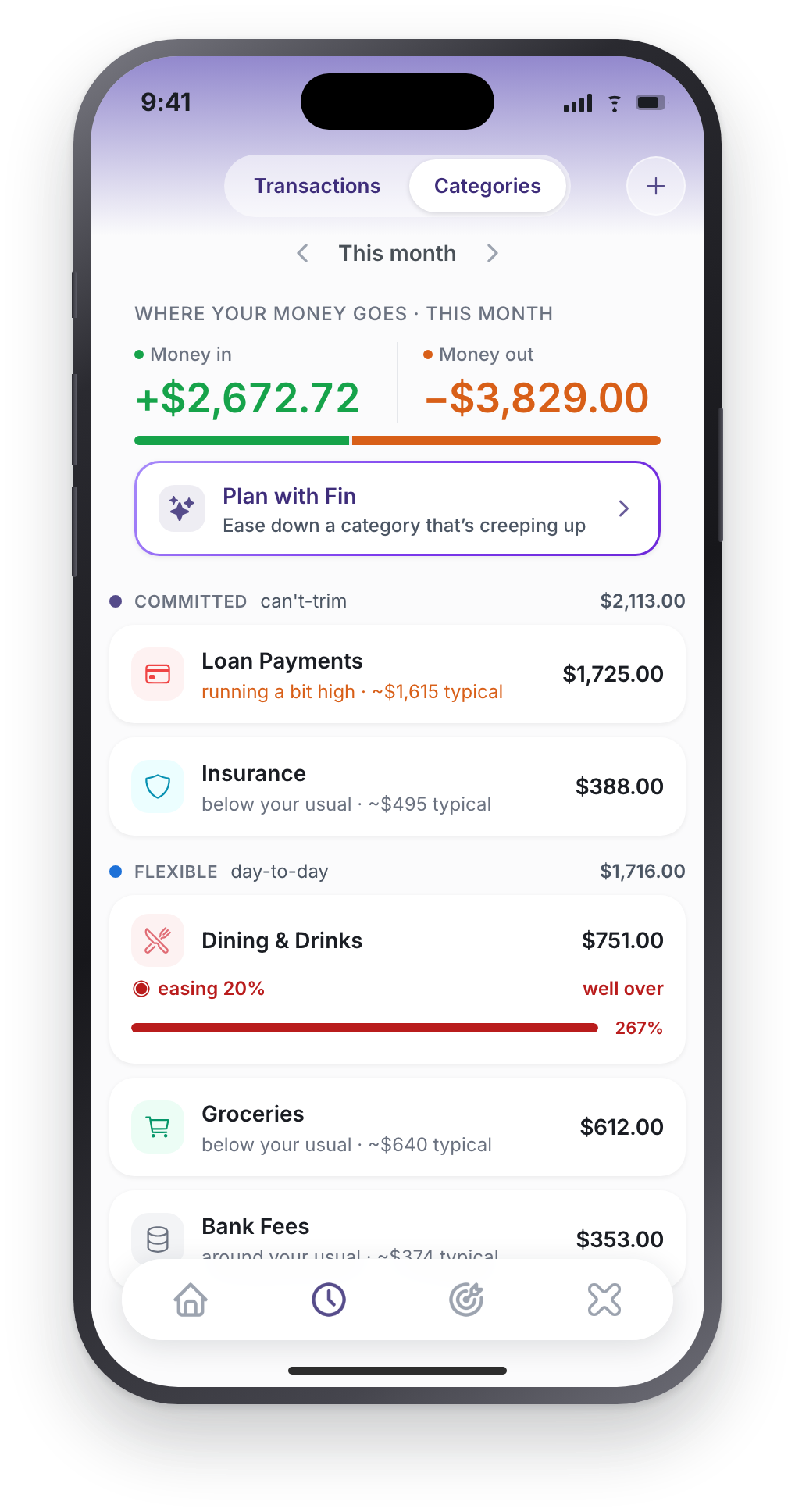
A focus is graded on pace: where your spending is heading by the end of the period, not whether you have crossed a line today. Spending $180 of a $200 target on the 4th and spending it on the 27th are not the same situation, and the app does not report them the same way. The verdicts are:
- Ahead of target. You are easing more than you set out to.
- On track. The projection lands on the eased target.
- Over pace. A little above, with the period still to run.
- Well over. The projection is not close.
The same verdict is used everywhere: the card on the Categories screen, the notification if you go over pace, and anything Fin says about it. They cannot disagree with each other, because they are the same computation.
Committed and flexible
Every category is sorted into one of two piles, and the sort is what makes the advice honest:
- Committed: rent, mortgage, insurance, utilities, loan payments. What you cannot trim week to week.
- Flexible: groceries, dining, shopping, transport, fun, and cancellable subscriptions. Day-to-day money you can steer.
A subscription counts as flexible even though it recurs, because you can cancel it. And when the app suggests easing back, it will only ever name a flexible category. Telling somebody to spend less on their mortgage is not advice.
Why it reports instead of advising
Xfin will not tell you whether a purchase is wise. It is not being coy, it simply does not have the facts that question needs.
It can tell you what is planned, what is not, and what is left after both. Whether spending it is wise depends on your job security, your family, your health and the car you have not told it about. An app that rules on that is making a promise on facts it does not have, and it is your money that pays for the promise.
What the easing is actually for
Cutting spending for its own sake is joyless and does not last. A focus is worth holding when it is buying something, so Xfin ties the two together: when your pace will miss a goal, it names the goal, names the category doing the damage, and tells you what easing that category buys: “Ease back ~$60.00/mo on Dining & Drinks and Emergency Fund arrives about 3 months sooner.”
That is the trade stated in the only unit that matters: time off the thing you are working toward. How goals work.